As the foundations of democracy threaten to crumble and crash, as decency and tolerance and moral imperative seem to become more and more invisible (non-existent even), as animosity and hatred replace civil discourse, in the midst of all this, a real miracle has occured. A very real miracle.
My son and daughter-in-law had a baby. A beautiful and healthy baby boy.
We are lucky that they live in same city as we do. After getting tested and quarantining, we have become a pod. That means we can all be together in one of our homes without masks. We can touch and hug and share food. These are also miracles under our present circumstances.
The baby is totally vulnerable, open, without protection or artifice or defense. When holding the baby, the world falls away. One’s focus becomes protecting the baby, alert to responding to his each and every need. Being totally and utterly caring. Being totally and utterly present in the moment. A glimmer of hope makes itself abundantly apparent, lifting all.
This wonderful and amazing miracle has arrived.
A reminder of the goodness, blessing, light, and love we yearn for. A reminder that there are still miracles.
According to Wikipedia, “The smoke signal is one of the oldest forms of long-distance communication. It is a form of visual communication used over a long distance. In general smoke signals are used to transmit news, signal danger, or gather people to a common area.” Smoke signals have been used all over the world and throughout history in many different cultures including China, ancient Greece, and the indigenous peoples of America.
Back in May and through the summer, the activity of writing postcards to voters (Postcards from the Edge) encouraging them to vote, helped to assuage some of the anxiety I was feeling about the election and about our democracy. Of course, the news has gotten progressively worse and crazier since the late spring and my anxiety continues as a persistent backdrop (and sometimes forefront) to each and every day.
The postcards I wrote had a date of October 30th printed on the front as the last date to request a mail-in ballot. Indivisible Chicago, who is sponsoring the particular postcards I wrote, requested that before we mail the cards on Oct. 24 we use a black marker and strike out this statement. Indivisible Chicago shared that while the legal deadline is the 30th in Michigan, that “voters who wait until the final week risk not receiving their paper ballot in time.” In other words, in the time between when the original postcards were printed and today, the risk of people not receiving their ballot in time or even their ballot not being counted has become a very real risk.
Today I struck out the line on all 500 of the postcards. I was angry that this was put on the cards in the first place. Angry that though it is legal for people to request mail-in ballots at such a late date, because of obstruction at the post office and danger of obstruction during and after the election, the chances are pretty high that anyone requesting such a ballot at the end of October will likely be disenfranchised. Angry that my country has slid into free fall regarding the fundamental right to vote.
Tonight we grilled fish for dinner. As I prepared to start the coals, I grabbed the sheets of names and addresses I was assigned for the postcard writing and stuffed them into the bottom of the charcoal chimney. I lit the paper and watched as the smoke in the charcoal chimney dispersed. For a brief moment, I really felt like I was sending smoke signals. I imagined Vance, Amber, Kameelah, Brett, Deontae, Mai, Dainesha, Bryan, Linda, Sky, and Towanda getting a whiff of this smoke and committing to vote. I imagined the smoke traveling over Grand Rapids, Southfield, Traverse City, Flint, cruising over Detroit, Warren, Ypsilanti, Dearborn, and Swartz Creek, reminding people to exercise their fundamental right to vote. I also imagined the smoke swirling around and undercutting those who would undermine these rights.
For the briefest of moments, I imagined the smoke signals from our house, from our hearts, smudging and purifying democracy.
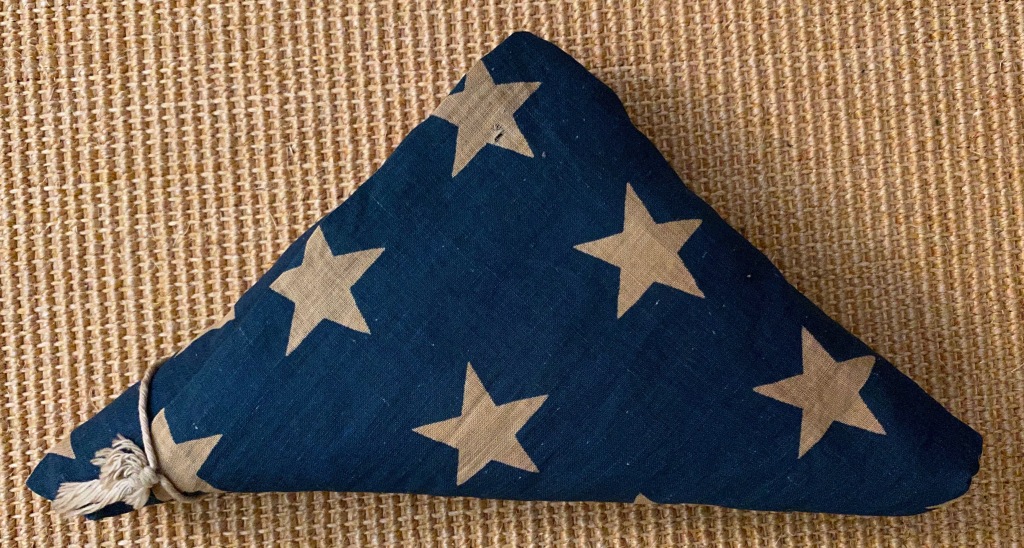
This is my grandmother’s American flag. It has 48 stars, before Alaska and Hawaii became states. I remember my father telling me that this flag was the very first thing she purchased when she came to the United States over 100 years ago (1906) from Kamenets Podolsky in the Ukraine– the very first thing she purchased once she and her family had settled in Toledo Ohio. He shared that story with me (I was maybe 11 or 12) because he was trying to convey to me how thrilled and blessed she felt to be here in this country. Actually I think he was really telling me how proud he was to be a citizen of this country. He fought in World War II in the Pacific and was filled with the democratic idealism of this country, as was his mom.
The flag sits on a shelf on a wall in our house along with lots of other pieces of collections and items accumulated over a lifetime. And today, for some reason, it caught my eye. I just stopped and stared at it. Strange. I am not even sure how I ended up with this 114 year old flag. I think my father stored it in an old trunk in the basement.
I take it down and unfold it. There are a few holes (bug holes?) in the weave. A small tear here and there. The white color has browned with age. The blue and red are still bold but with a thin veneer of the fogginess of a century of time, especially along the top border over the field of stars. The top metal grommet is missing but someone, probably my grandmother, has stitched around the hole to keep it from unravelling. Clearly this flag was used, hung, displayed. I imagine my grandmother purchasing this flag and carrying it home. I imagine her hanging it on her front porch, perhaps for her very first July 4th. I imagine her repairing it. I hold the flag and imagine her holding it.
I think of how my grandmother Kate and my father would react to what is happening in our country right now. How the meaning of this flag has somehow been distorted from when she first purchased it. Or even from when my father fought for it. The democratic values they were so proud to embrace and support are now struggling for survival. My grandmother and father would never believe what has happened to this country, especially around the fundamental issue of the right to vote. I’m glad they are not here to see how quickly this democracy has cracked, how very vulnerable this democracy apparently has always been.
I want to believe we can set things right, but a lot is broken and has been broken for a very, very long time, from way before my grandmother and grandfather found their way here. Right now I am feeling great grief. It is grief about the loss of my own innocence —the belief that democratic institutions were pretty solid and that there were these universal values of inclusion and equity embedded there that most of us agreed with and were continually working on. It is grief at the loss of the naive belief that goodness is right and will win in the end against evil and greed, because it is, well, good. I hold this flag and now find I am holding something much more complicated. I am holding both hope as well as deep despair that things may not work out for the better. I am holding both the energy needed to keep working for justice as well as a much more realistic understanding of the power of the obstructions, distractions, and illusions on this uncharted journey. I am holding both the dream and the nightmare.
I hold the flag and imagine my grandmother Kate holding it too. So that it will not unravel, my responsibility is its repair.
Many years ago my sister and her wife bought me a punching bag for my birthday, an Everlast. It was gifted as a way for me to get some aerobic exercise especially in the cold winter months. We put it up in our basement and periodically I have used it. It is actually fun to use and, yes, definitely aerobic. But I never have been disciplined or consistent about its use. Until now.
It happened about a month ago. I had just finished reading the news and was in my usual state of disbelief, despair, and incredulity and went into the basement. I passed by the bag and—— I punched it. I couldn’t stop for at least 10 minutes. I felt a sense of release and renewal, empowerment even. It became the conduit and drain for my feelings of exasperation at the place my country has sunk. After reading the news, the punching bag now helps me to realign and readjust all my despair muscles and helps me to strengthen my reason, my resolve, my sense of empowerment and of community.
Of course, it is not the only way I am responding to these times. I have been writing postcards (so far personally 500 of them), phone banking, donating, reading lots of books and articles pertinent to these times and discussing them with friends and family. I am an active member of several social justice organizations. I am making serious and concerted efforts at being more thoughtful and aware about the way I move through this world and interact with others.
We all know the times we are living in are unprecedented. We are in the midst of many crises and these crises have drawn back the veil from the cracks in our fantasy of the democracy we thought we lived in and even, perhaps, the fantasies we have held of ourselves. We can work to repair these broken places. We can take responsibility and be accountable for our misperceptions, denial, ignorance, and exclusion. There is so much to do it can feel overwhelming. But we need to roll up our sleeves, take a few punches on the Everlast, and then get on with the work. This is the real exercising we all need to be doing. There is no other choice.
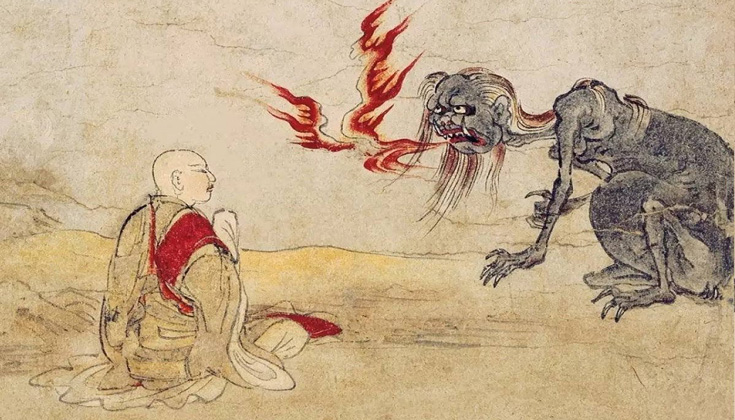
Today is the Hungry Ghost Festival celebrated during the seventh month of the lunar calendar, known as Ghost Month, coinciding with the full moon. It is celebrated in Buddhism, Taoism, and Hinduism and also in many East Asian folk religions. On the fifteenth day of the month, all the hungry ghosts are released and are allowed to wander in the world of the living for a month. The intention of this festival is to honor one’s ancestors and dutiful family members burn joss paper clothes and money to help ease one’s ancestors’ suffering in the afterlife. In fact, this year, one Hong Kong establishment is selling joss paper face masks for the celebration. (Even hungry ghosts need to social distance!) Some celebrate by providing lavish trays of food and sweet treats for their ancestors.
Specifically in Buddhism, a hungry ghost is known as a preta, “a spiritual being damned to suffer great pangs of intense need in the afterlife for displays of greed, theft, or violence while living.” (Lion’s Roar email 8/28/20) A hungry ghost is quite literally suffering karmic retribution in the afterlife for committing these heinous deeds while alive.
A hungry ghost’s unending desire can never be satiated because they have a pin-hole mouth or in some cases a mouth that contains flames so that any nourishment is immediately burned up before it can come inside. They also have very, very thin necks, without any space for nourishment to travel. Hungry ghosts also have the caricatured large, extended bellies of those who are starving. Though living celebrants put food out for the hungry ghosts in hopes that it will help to ease their suffering, it can also serve as a teasing taunt to hungry ghosts who are unable to get any of the gifts of nourishment inside their bodies and so are constantly frustrated, ungratified, unfulfilled, and angry. Always hungry, they can never consume enough to ease the suffering of their hunger. Suffering from such unquenchable desire can never be sated. This is the lesson of the hungry ghost.
The suffering of a hungry ghost however, is a temporary punishment. Once the karmic sentence has been served, one can be reborn into a new life and hopefully work, when human again, towards enlightenment and avoid ever being a hungry ghost again. Redemption is always possible, unlike the damnation of an infinitely eternal hell.
In one way or another, we are all hungry ghosts. Our society, our economy, is built on the false promise of satisfying an insatiable hunger. We are never satisfied with what we have and are always desirous of more and more, believing we will find some sense of contentment or happiness in acquiring more and “better.” This is what drives and what defines capitalism. This mindset can also exploit our politics in protecting the powerful who want even more, at the expense of everyone else.
We are all hungry ghosts and the time for reincarnation is now. This reincarnation has never been more urgent. We have served our karmic sentence. It’s time to focus on our redemption—our shared humanity, our connections, our intra- and interdependence. May the memory of this collective sentence of our karma as hungry ghosts awaken us beyond our own selfish desires to the more generous understanding that we are all, in fact, one community. May we rebirth ourselves and our society with the awareness that we affect and are affected by everyone’s experience and life, that we are all inextricably linked.
May we learn from the suffering of the hungry ghosts that we can only be truly nourished when everyone is nourished. This is the only redemption.
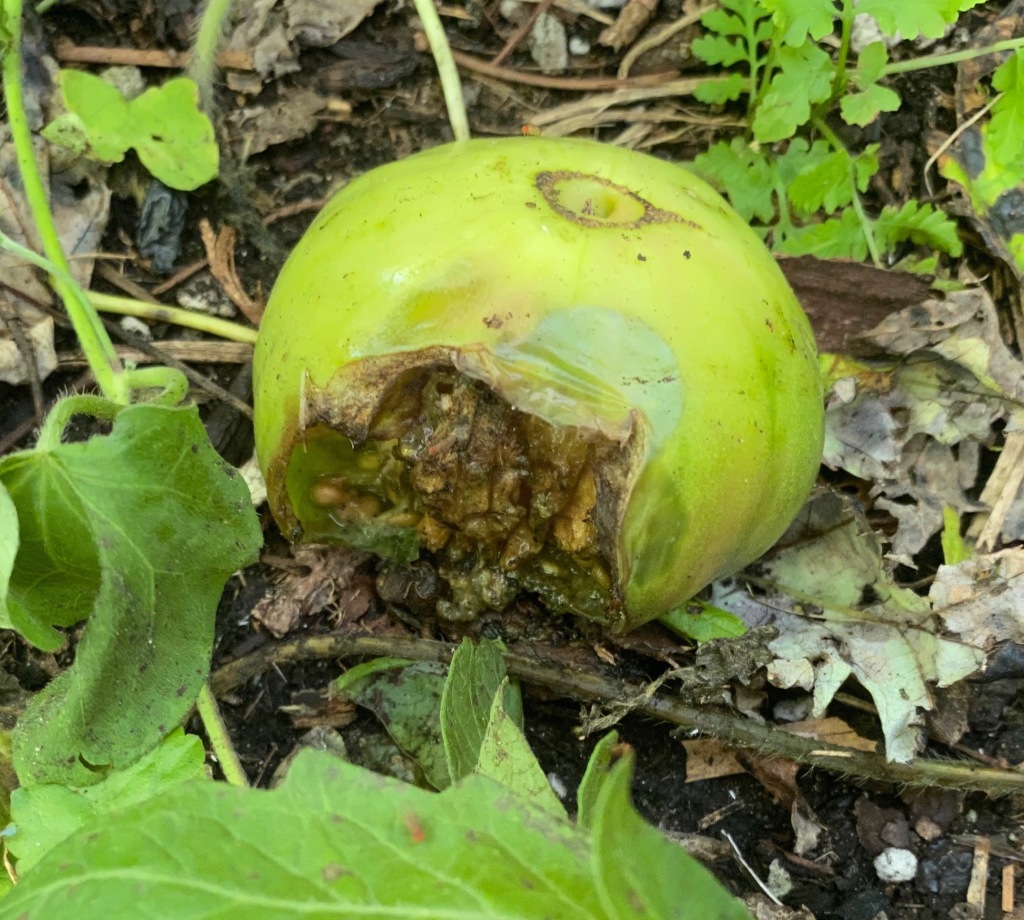
I don’t mind sharing with the squirrels, but they take one or two bites and then leave the tomato to rot! I wish they would at least finish what is on their plate before they reach for another.
My aunt, my mother’s twin, had a black lawn jockey on her front lawn. It appeared some time in the 60s in the midst of the Civil Rights movement. My cousin, my aunt’s daughter, told me that actually her mother had had two. One was vandalized (smashed) by someone. Then my aunt got another and painted it with polka dots on his clothes, white hair and eyebrows like an old Uncle Tom, and a garish, cartoony face. My cousin lives in her childhood home and said the (second) lawn jockey was still in the garage. She sent me this photo of it this morning.
My family was liberal, at least I felt certain my father and mother were. They were open-minded and always told me that black people were equal to everyone else. But I don’t think they ever said anything to my aunt about the lawn jockey on her front lawn.
The fact that my aunt got a second one after the first had been vandalized is incredibly disturbing to me. Was she daring the vandalizer to come back? Was she telegraphing to the vandalizer that she would win this? That whites always do? And why did she paint the lawn jockey in the way she did? It seems obvious to me she was mocking black people, but I’m not entirely sure she saw it that way. I think she thought it was humorous, not racist mockery. Why was my aunt trying to evoke attitudes of the “Old South” on Bowen Road in Toledo Ohio in the 1960s?
Brown v Board of Education 1954, Emmett Till 1955, Rosa Parks 1955, Little Rock Nine 1957, Woolworth’s lunch counter 1961, Freedom Riders 1961, Birmingham church bombing 1963, March on Washington 1963, Civil Rights Act 1964, Selma to Montgomery March/ Bloody Sunday 1965, Voting Rights Act 1965, Assassination of Malcolm X 1965, Assassination of Martin Luther King 1968. This lawn “ornament” was not a random purchase. There was intention here.
I don’t know exactly when she first put the lawn jockey in front of her house (as it is unclear when it got permanently put into the garage), but it is clear I remember it. I remember it because it bothered me, but I doubt whether I said anything to my aunt either. I remember the polka dots and the garish face making me feel as if she had made a burlesque out of the serious idea of equality. I hadn’t remembered the white hair until I saw the photo this morning. I have a very vague memory of talking about it with my parents or maybe I just remember my parents talking about it in the car. Or maybe none of us said anything about it. Maybe we just “thought” our responses to it. And why is it still in my cousin’s garage?
On Facebook, someone described that before the Civil War, black lawn jockeys were put in front of houses as signals for the Underground Railroad. Different signifiers were tied to the jockey or colors painted on them to signal safe houses or safety information in general. This, of course, was not why my aunt placed one on her front lawn. Was she signaling her fear of what she saw as the world changing in a way that made her uncomfortable? She clearly felt safe to publicly broadcast her disdain for black people. What pushed her–twice— to do that? These many years later, I understand she was simply demonstrating her privilege and superiority in a system steeped in racism. And so were my parents (and her neighbors) by not saying anything to her. We were all demonstrating, what Robin DiAngelo describes as, white solidarity.
My aunt had an African American cleaning lady, Josie, who came to her house weekly and ironed my aunt’s family’s clothes as well as cleaned her house. What did Josie think when she saw this jockey on my aunt’s front lawn? I have this fantasy that Josie came home one day and told her family about the lawn jockey and one of her kids got a bunch of his friends together and they drove to my aunt’s house and trashed the jockey. I hope so. I wonder why they didn’t bother with the second one. I have some shame why I didn’t bother with it either.
This was printed in the Opinion Column of the New York Times today, July 30, 2020.
Mr. Lewis, the civil rights leader who died on July 17, wrote this essay shortly before his death, to be published upon the day of his funeral.
While my time here has now come to an end, I want you to know that in the last days and hours of my life you inspired me. You filled me with hope about the next chapter of the great American story when you used your power to make a difference in our society. Millions of people motivated simply by human compassion laid down the burdens of division. Around the country and the world you set aside race, class, age, language and nationality to demand respect for human dignity.
That is why I had to visit Black Lives Matter Plaza in Washington, though I was admitted to the hospital the following day. I just had to see and feel it for myself that, after many years of silent witness, the truth is still marching on.
Emmett Till was my George Floyd. He was my Rayshard Brooks, Sandra Bland and Breonna Taylor. He was 14 when he was killed, and I was only 15 years old at the time. I will never ever forget the moment when it became so clear that he could easily have been me. In those days, fear constrained us like an imaginary prison, and troubling thoughts of potential brutality committed for no understandable reason were the bars.
Though I was surrounded by two loving parents, plenty of brothers, sisters and cousins, their love could not protect me from the unholy oppression waiting just outside that family circle. Unchecked, unrestrained violence and government-sanctioned terror had the power to turn a simple stroll to the store for some Skittles or an innocent morning jog down a lonesome country road into a nightmare. If we are to survive as one unified nation, we must discover what so readily takes root in our hearts that could rob Mother Emanuel Church in South Carolina of her brightest and best, shoot unwitting concertgoers in Las Vegas and choke to death the hopes and dreams of a gifted violinist like Elijah McClain.Like so many young people today, I was searching for a way out, or some might say a way in, and then I heard the voice of Dr. Martin Luther King Jr. on an old radio. He was talking about the philosophy and discipline of nonviolence. He said we are all complicit when we tolerate injustice. He said it is not enough to say it will get better by and by. He said each of us has a moral obligation to stand up, speak up and speak out. When you see something that is not right, you must say something. You must do something. Democracy is not a state. It is an act, and each generation must do its part to help build what we called the Beloved Community, a nation and world society at peace with itself.
Ordinary people with extraordinary vision can redeem the soul of America by getting in what I call good trouble, necessary trouble. Voting and participating in the democratic process are key. The vote is the most powerful nonviolent change agent you have in a democratic society. You must use it because it is not guaranteed. You can lose it.
You must also study and learn the lessons of history because humanity has been involved in this soul-wrenching, existential struggle for a very long time. People on every continent have stood in your shoes, through decades and centuries before you. The truth does not change, and that is why the answers worked out long ago can help you find solutions to the challenges of our time. Continue to build union between movements stretching across the globe because we must put away our willingness to profit from the exploitation of others.
Though I may not be here with you, I urge you to answer the highest calling of your heart and stand up for what you truly believe. In my life I have done all I can to demonstrate that the way of peace, the way of love and nonviolence is the more excellent way. Now it is your turn to let freedom ring.
When historians pick up their pens to write the story of the 21st century, let them say that it was your generation who laid down the heavy burdens of hate at last and that peace finally triumphed over violence, aggression and war. So I say to you, walk with the wind, brothers and sisters, and let the spirit of peace and the power of everlasting love be your guide.
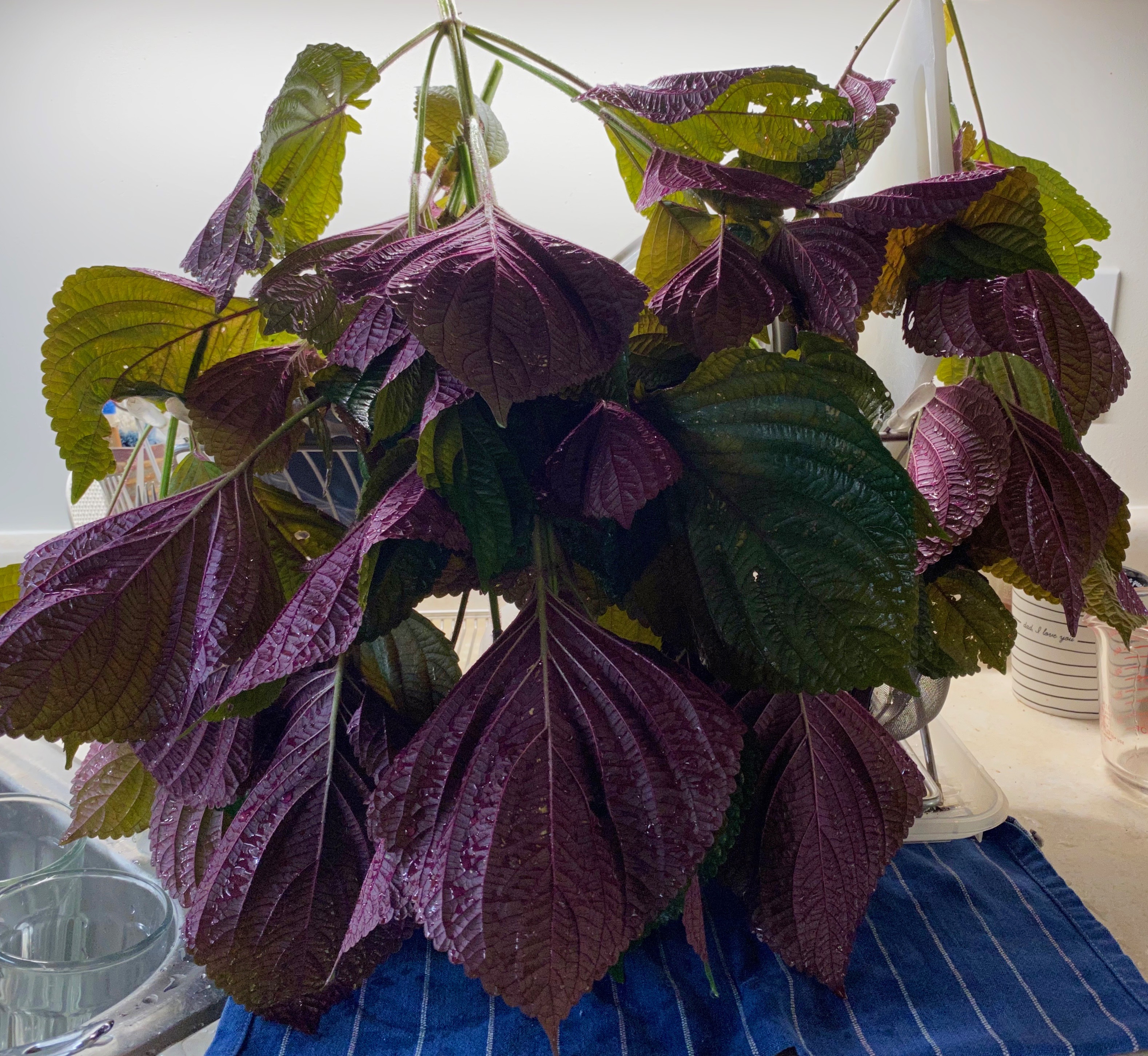
This year the shiso is growing everywhere, three kinds– green, red, and bi-color. Last year we let all the shiso go to seed and the plant– lush, resilient, and exuberant — has placed itself into every nook and cranny in the garden: in between the tomatoes, in the path, under the fence, around the lilies, behind the compost, beneath JB’s steel sculpture, even around the coils of the garden hose. We use the leaves fresh, but this is the first year we have decided to also dry the leaves, having read of it being used for tea and dried spice.
Shiso is in the mint family (perhaps that is why it is so easy to grow!) and, depending on which variety you are consuming, has a different balance of anise, cinnamon, clove, licorice, and basil flavors. If you have eaten at Japanese restaurants before you have probably seen it, usually aesthetically placed underneath the small mound of wasabi on the plate. Our son fell in love with shiso when he was teaching in Japan and brought his love for Ume Shiso Maki home with him.
My mother’s favorite flavor was licorice and anise. She could easily polish off a bag of black licorice (laces, twists, ropes, vines or wheels) as if it were a bowl of popcorn. And today is her birthday. She (and her twin) would have been 93. To celebrate, I am drying three kinds of shiso. She would have loved shiso. She would have loved it sprinkled, fresh or dry, on all her food. It would have made every meal for her seem like dessert.




 My aunt, my mother’s twin, had a black lawn jockey on her front lawn. It appeared some time in the 60s in the midst of the Civil Rights movement. My cousin, my aunt’s daughter, told me that actually her mother had had two. One was vandalized (smashed) by someone. Then my aunt got another and painted it with polka dots on his clothes, white hair and eyebrows like an old Uncle Tom, and a garish, cartoony face. My cousin lives in her childhood home and said the (second) lawn jockey was still in the garage. She sent me this photo of it this morning.


 Nexus
Nexus 